
Consumer Unit Replacement: Signs, Rules and What RCBOs Do
Consumer unit replacement is usually needed when a fuse box has rewireable fuses, no RCD protection, a plastic enclosure with signs of heat damage, or no space for new circuits such as an EV charger. A replacement takes most of a day, is notifiable under Part P, and must be tested and certified by a qualified electrician.
Sam Ward Electrical, NAPIT registered (membership 63406). Last reviewed:
At a glance
- Common reasons
- Rewireable fuses, no RCDs, heat damage, no spare ways for new circuits
- Time
- Most of a day, with the power off for several hours
- Enclosure
- New domestic consumer units have non-combustible (usually steel) cases
- Paperwork
- Electrical Installation Certificate and Part P notification
- Also check
- Existing circuits are tested first, and faults may need fixing before switch-on
When is consumer unit replacement needed?
Consumer unit replacement is usually needed in one of these situations:
- The board still uses rewireable fuses or very old cartridge fuses
- There is no RCD protection, or only some circuits are protected
- The enclosure shows scorching, melting or a burning smell
- There is no space for a new circuit, such as an EV charger, shower or garden supply
- An EICR has recommended an upgrade
- You are having a rewire or major renovation
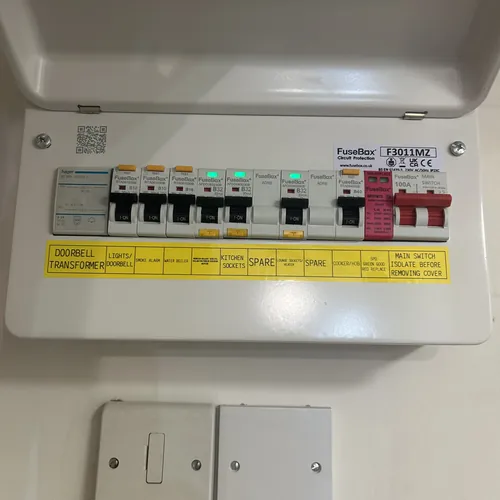
What is the difference between an RCD, an MCB and an RCBO?
An MCB protects a circuit against overload and short circuit, an RCD protects people against electric shock by detecting earth leakage, and an RCBO does both jobs for a single circuit.
| Device | Protects against | Covers |
|---|---|---|
| MCB (miniature circuit breaker) | Overload and short circuit | One circuit |
| RCD (residual current device) | Earth leakage, which helps prevent electric shock | A group of circuits |
| RCBO | Overload, short circuit and earth leakage | One circuit, so a fault trips only that circuit |
| SPD (surge protection device) | Voltage surges, for example from lightning | The whole installation |
A board with an RCBO on every circuit means one fault no longer switches off half the house.
Why do new consumer units have metal cases?
Since 2016, the wiring regulations (BS 7671) have required consumer units in homes to have a non-combustible enclosure, usually steel, to contain a fire if a connection overheats. An existing plastic consumer unit in good condition does not have to be replaced just for this reason, but any replacement will be metal.
What happens during a consumer unit replacement?
A consumer unit replacement usually takes most of a day:
- Test the existing circuits so any hidden faults are found before the new board goes in.
- Isolate the supply and remove the old board.
- Fit the new consumer unit with RCBOs or RCDs, surge protection and correct labelling.
- Test and certify every circuit, issue an Electrical Installation Certificate and notify the work under Part P.
Older circuits sometimes fail the new, more sensitive protection; if that happens the fault must be fixed before the circuit can be switched back on.
Do I need a new consumer unit for an EV charger or solar panels?
Not always. A charger or solar system needs a suitable spare way and the right protection. If your board has neither, consumer unit replacement is often the tidiest solution, and it can be done on the same visit as the EV charger installation or solar work.
Sources and further reading
- Approved Document P: electrical safety in dwellings (GOV.UK)
- BS 7671 wiring regulations (IET)
- Electrical Safety First