
Home EV Charger Installation: A Step-by-Step Guide
A home EV charger installation puts a smart charge point on its own circuit from your consumer unit, with protection against earthing faults on most supplies. A qualified electrician surveys your supply first, fits and tests the charger, certifies the work and notifies the network operator. Most installs take about half a day.
Sam Ward Electrical, NAPIT registered (membership 63406). Last reviewed:
At a glance
- Typical charger
- 7kW single-phase smart charger
- Time on site
- About half a day for most homes
- Paperwork
- Electrical Installation Certificate, Part P notification and network operator notification
- You need
- Off-street parking for a standard home charger
- Smart rules
- New chargers must have smart functions (since 30 June 2022)
What happens before a home EV charger installation?
Before a home EV charger installation, the electrician surveys your supply to make sure it can take the extra load safely. The survey covers:
- The main fuse rating and how much power the house already uses at busy times
- Whether the consumer unit has space and suitable RCD protection for a new circuit
- The earthing arrangement, which decides how the charger is protected
- The cable route from the consumer unit to where you park
- Wi-Fi or mobile signal at the charger position, so the smart features work
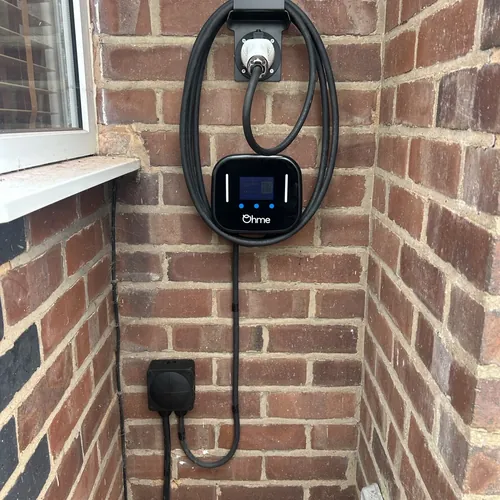
How is a home charger installed?
The charger is installed on a dedicated circuit in five steps, usually within half a day:
- Mount the charger on an outside wall or in a garage, close to where the car's charging port will be.
- Run the cable from the consumer unit, often through the wall and clipped neatly along it or buried for longer runs.
- Connect the circuit to a suitable protective device and RCD in the consumer unit.
- Test the installation and commission the charger, including the app and charging schedule.
- Certify and notify by issuing an Electrical Installation Certificate, registering the work under Part P and notifying the network operator.
Why does earthing matter for EV chargers?
Earthing matters because most UK homes have a PME (TN-C-S) supply, where the neutral and earth share one conductor in the street. If that conductor were ever broken, the metal body of a car connected outdoors could become live. The wiring regulations therefore require extra protection: either a charger with built-in open-PEN detection or a separate earth rod. A good installer checks which option suits your home.
How fast does a home charger charge a car?
A 7kW home charger adds roughly 25 to 30 miles of range per hour. The table shows approximate figures; the real rate depends on the car.
| Supply | Power | Range added per hour (approx.) |
|---|---|---|
| Standard three-pin socket | 2.3kW | About 8 miles |
| Home charger, single-phase | 7kW | About 25 to 30 miles |
| Three-phase charger | 11kW | About 40 miles |
| Three-phase charger | 22kW | Up to about 75 miles, if the car accepts 22kW |
Do home EV chargers have to be smart?
Yes. Under the Electric Vehicles (Smart Charge Points) Regulations 2021, home and workplace chargers sold in Great Britain since 30 June 2022 must be able to connect to the internet, respond to signals to change their charging rate, and avoid peak times by default unless you override them. In practice this lets you charge on cheaper off-peak tariffs automatically.
Can I get a grant towards a home charger?
Possibly. GOV.UK lists chargepoint grants for renters and flat owners, households with only on-street parking using approved cross-pavement solutions, landlords and workplaces. Rules and amounts change, so check current eligibility on GOV.UK before booking.
What affects the cost of a home EV charger installation?
The cost of a home EV charger installation depends on the charger model, the cable length and route, whether the earthing needs an earth rod, and whether the consumer unit needs upgrading first. We explain each of these when we quote rather than publish a single price, because they vary so much between homes.
Sources and further reading
- Electric Vehicles (Smart Charge Points) Regulations 2021 (legislation.gov.uk)
- Electric vehicle chargepoint grants (GOV.UK)
- Approved Document P: electrical safety in dwellings (GOV.UK)